

The world’s most-watched sporting event, the FIFA World Cup, kicks off today, 11 Jun 2026. The once-every-four-years spectacle is co-hosted by Canada, Mexico and the US, and this edition is the biggest ever, with 48 teams, 104 matches and 16 host cities. It opens with co-hosts Mexico facing South Africa at the iconic Estadio Azteca in Mexico City.
FIFA has even put out an official Socioeconomic Impact Analysis for World Cup 2026. The headline estimate is around US$40.9 billion in global GDP impact and over 823,000 full-time-equivalent (FTE) jobs worldwide. For the US alone, the estimate is about US$17.2 billion in GDP and 185,000 FTE jobs.
But of course, estimates are estimates, so take them with a pinch of salt. Plenty of economists reckon the real numbers tend to come in well below FIFA’s projections.
Still, intuitively we know some companies stand to benefit. So let’s run through the stocks we think will catch a tailwind.
#1 Sports Brands, Especially Adidas (ADDYY)
Adidas came back swinging as a kit sponsor. It has the most teams in the tournament, dressing 14 countries. More countries means more jerseys to sell to supporters, and the more the merrier, especially for crowd favourites like reigning champion Argentina and World Cup hopeful Spain.
Adidas (14): Mexico; Japan; Argentina; Colombia; Algeria; South Africa; Qatar; Saudi Arabia; Germany, Belgium, Spain, Scotland, Curacao, Sweden
Nike (12): USA; Canada; South Korea; Australia; Brazil; Uruguay; England; France; Croatia; Norway, Netherlands, Turkey
Puma (11): New Zealand; Paraguay; Morocco; Egypt; Ghana; Ivory Coast; Senegal; Portugal; Austria, Switzerland, Czech Republic
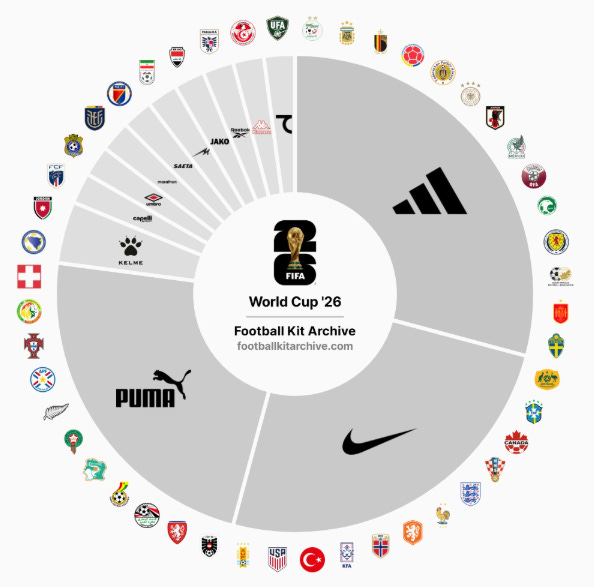
The picture was completely different in World Cup 2022, when Nike sponsored the most teams and Adidas came in second. So Adidas has wrestled the throne away for 2026. And let’s not forget that Adidas has supplied the official match ball for every World Cup since 1970.
So it’s likely Adidas’s revenue gets a bigger bump than the other two this year. Investors seem to have already taken note. Adidas stock has jumped about 19% over the past month. Nike and Puma haven’t come close, up about 4% over the same period.
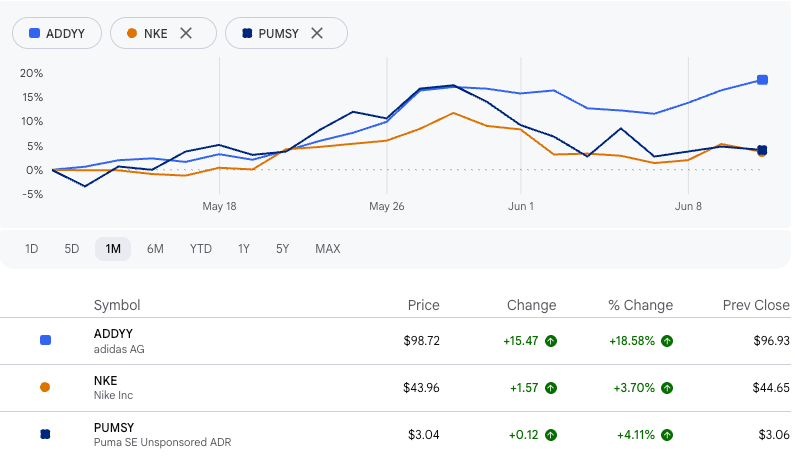
What’s worth noting is how the analyst calls have split. On 9 Jun, RBC upgraded Adidas to “Outperform” and lifted its target from €170 to €210, partly citing the brand’s World Cup push in the US (including a joint campaign with DICK’s Sporting Goods). A day later, literally on the eve of kickoff, RBC went the other way on Nike, cutting it to “Sector Perform” with a $50 target and warning that its turnaround is taking longer than expected.
Just don’t mistake a marketing moment for a fixed business. The whole sportswear sector is still wrestling with excess inventory and softer demand in China, and we’ll only see whether the on-pitch visibility converts into actual sales when Adidas reports on 30 Jul. For now, the rally is running on the story alone.
#2 Travel Platforms And Hotels
This is another obvious group of beneficiaries. Loads of tourists, all needing a place to stay and a way to navigate three host countries.
Airbnb has been talking up World Cup demand. It launched a US$750 new-host incentive across the 16 host cities and said hosts could earn about US$3,000 on average during the tournament, based on Deloitte estimates. It also reported a wave of new listings in host cities since its outreach began, and that a meaningful share of tournament-time guests are first-time Airbnb users.
On rates, some market reports flag match-day spikes, with examples of New York / New Jersey short-term rentals listed above 600% and even 1,500% of normal, though those are outliers and not necessarily booked rates.
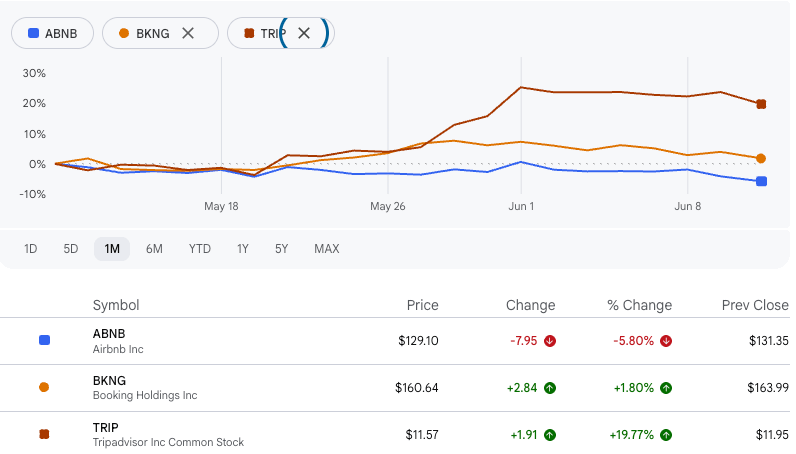
For the broader hotel and OTA market, data from Lighthouse reportedly showed average US host-city hotel prices tracking well above year-ago levels, with Canada and Mexico host cities even higher, and a further jump after the draw. Among the operators, Marriott (MAR) has the most direct relationship, since Marriott Bonvoy is the Official Hotel Supporter in North America for the tournament. Goldman has also reportedly flagged Hyatt, Marriott and Hilton as beneficiaries of World Cup travel demand.
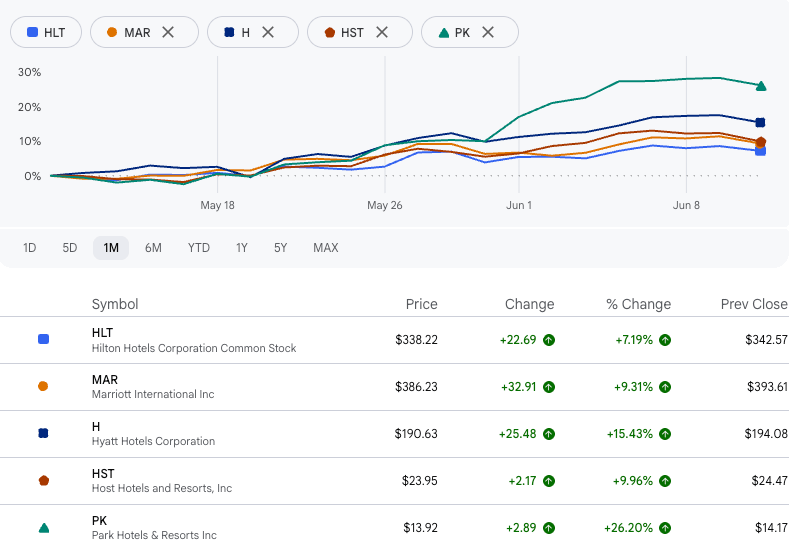
But here’s the twist. The demand isn’t showing up the way everyone assumed. Reuters reported just ahead of kickoff that the World Cup has so far failed to deliver the expected international visitor surge, with hotels and airlines seeing softer demand thanks to high ticket prices, visa friction, and the logistics of a multi-city, three-country tournament. New York’s Hilton Midtown, the city’s largest hotel, reportedly slashed its tournament rates in half to about US$415 a night, and roughly 80% of US hotels surveyed by the American Hotel and Lodging Association said bookings were tracking below forecast.
So we’ve got a classic disconnect. Stocks are rallying on the World Cup hospitality story, while the actual booking data is showing softness in some US host cities. Worth keeping in mind before you assume hotels are a sure thing.
#3 Sports Betting
The biggest sporting event on earth also means more people placing bets. FanDuel and DraftKings are the two giants of US online sports betting, together controlling roughly 80% of the market. DraftKings (DKNG) is listed directly, while FanDuel sits under Flutter (FLUT).
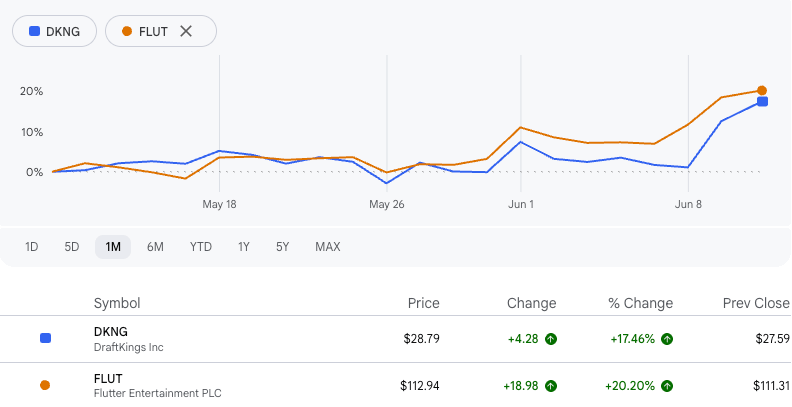
DraftKings has reportedly geared up for “massive” World Cup action with expanded live betting, player props and same-game parlays across the 104-match tournament. FanDuel has its own dedicated World Cup 2026 odds hub, with match odds, group previews, predictions and best bets.
The real margin isn’t in simple bets like who lifts the trophy. It’s in the complex, story-driven bets where punters stack many low-probability outcomes into one high-payout slip, things like same-game parlays, live betting, player props, accumulators and bet boosts. That’s where the house edge fattens.
The World Cup is a meaningful customer-acquisition and reactivation event for both. In fact, Flutter has openly pointed to the World Cup and the upcoming NFL season as catalysts for a rebound. But the real upside depends on whether those casual users keep betting after the tournament ends, especially heading into NFL season. Not forgetting both are facing competition from prediction markets too.
Takeaway
The largest sporting event is here, and some stocks will benefit, albeit temporarily, but better than nothing. Not all of these are worthy long-term investments, but with the AI trade in a correction phase, a few could offer short-term trading opportunities and may get a lift from the World Cup effect.
Just don’t trade without a strategy. That would be no different from placing a punt on DraftKings or FanDuel.
Hi Alvin, thanks for the great write-up! I saw you mentioned that RBC cut Nike to "Sector Perform" and warned that "its turnaround is taking longer than expected," and I was wondering if that drawn-out turnaround, combined with Nike ceding ground to Adidas on World Cup jersey sponsorships and the stock lagging its peers over the past month, is a sign of failed strategic initiatives or missed guidance that could eventually draw activist attention if the underperformance persists.