
Tariffs and Slower Consumption Should Impact Apparel Stocks, But Instead, They Rallied

In the previous article, I mentioned that healthcare and biotech stocks were outperforming tech and AI.
But there’s an even less obvious segment that’s quietly crushing tech: apparel and footwear.
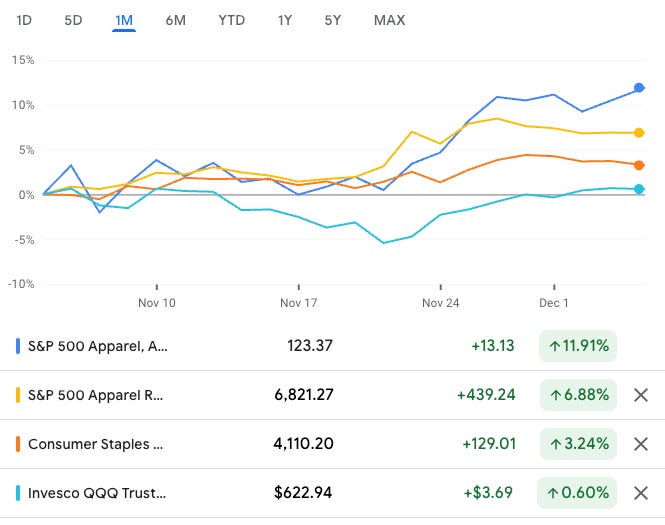
The S&P 500 Apparel & Luxury Goods Index delivered 11.91% in the past month. The S&P 500 Apparel Retail Index? 6.88%. Meanwhile, the tech-heavy QQQ ETF crawled along at 0.6%.
Why is this less obvious? Because no one’s talking about it. There are no flashy ETFs tracking this corner of the market, and the media sure isn’t covering it.
And it’s unlikely, too. The narrative right now is that US consumption is slowing—so discretionary purchases like clothing should be getting hammered, while consumer staples hold up. But the numbers tell a different story. Apparel indices outperformed consumer staples, which only gained 3.24% over the same period.
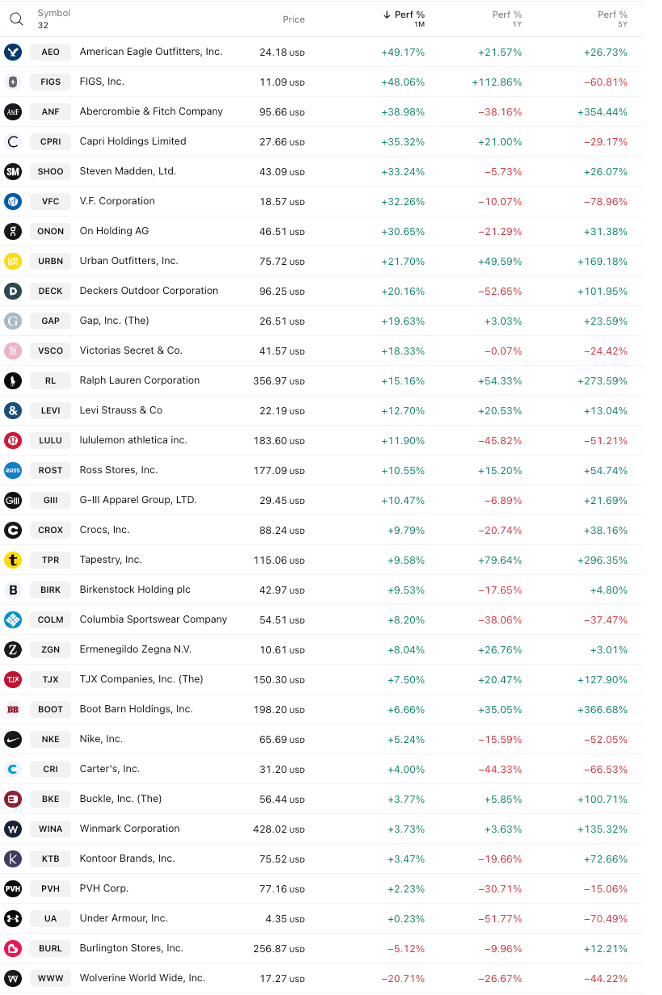
Footwear? Same thing. Steven Madden up 33%. On up 31%. Deckers up 20%. This isn’t one or two outliers—it’s the entire industry making serious gains. Below is the list of apparel and footwear stocks with at least $1B market cap.
Why Is This Happening?
Mean reversion.
Many of these stocks got crushed over the past year. Abercrombie, Deckers, Lululemon—all down more than 30%. So what we’re seeing isn’t a rally to new highs. It’s a rebound from oversold levels.
These stocks are also more volatile than staples. When they snap back, they snap back hard. That explains the short-term outperformance.
Previously, investor sentiment was bearish—inflation fears, consumption slowdown, the usual doom loop. With Trump, add in tariff impact. But recent results showed the pessimism was overdone. Once that corrected, the stocks bounced.
That said, not every rebound is real. Some of these stocks are still in downtrends, and the recent bounce is just part of the zigzag on the way down.
So let’s use some technical analysis to separate the ones that have actually bottomed from the ones still sliding.
