

When Iran largely shut the Strait of Hormuz in March, Saudi Arabia had a backup plan. Last week, that plan came under pressure from both ends.
Oil jumped. Brent crude rose about 3% to around $108 a barrel in early Monday trading, after gaining almost 9% the week before.
Three Ways Out
Look at the map. Saudi oil has three main ways to reach the world.
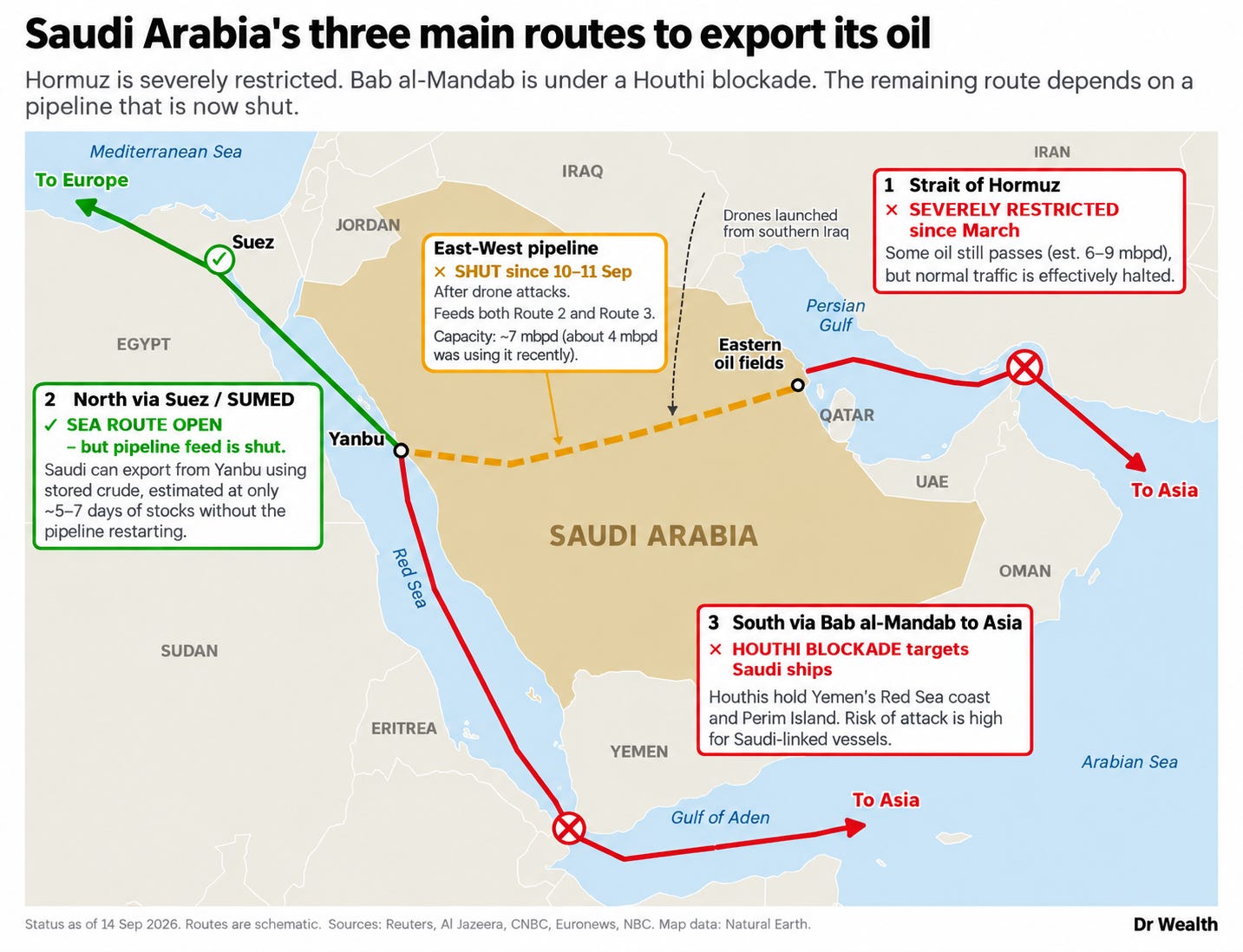
The first is the Strait of Hormuz, at the mouth of the Persian Gulf, where most Saudi oil traditionally leaves. Normally about a quarter of the world’s seaborne oil passes through it. Since March, traffic has been severely restricted and the strait has been effectively closed to normal commercial flows.
The second and third start with the same pipe.
The East-West pipeline runs about 1,200km across the desert, from Saudi Arabia’s oil fields in the east to the port of Yanbu on the Red Sea. From Yanbu, tankers can either sail north through Egypt’s Suez Canal or SUMED system toward Europe, or south through the Bab al-Mandab strait, past Yemen, toward Asia.
Yanbu was shipping around 4 million barrels a day by June, up from under 1 million a year earlier. More than 80% of it was going to Asia.
On 10 September, drones struck multiple sites along the East-West pipeline and set facilities ablaze. Saudi Arabia shut the pipeline as a precaution the following day.
The drones did not come from Yemen. Iraq’s prime minister’s office confirmed that they originated from Iraq. Baghdad subsequently dismissed the military commander responsible for Maysan province in southern Iraq. No one has claimed responsibility for the attack, although Iran-backed militias in Iraq have used drones against Saudi Arabia before.
At the other end, the Houthis in Yemen seized Mokha, Dhubab and Perim Island, which sits in the middle of the Bab al-Mandab and splits the strait into two shipping channels. They now hold the key positions on Yemen’s side of the strait.
So Saudi Arabia has a problem.
Hormuz is largely shut.
The route south to Asia now runs past Houthi-held territory.
That leaves the northern route through Suez, which is fed by the very pipeline that is now shut.
Yanbu has enough stored crude for roughly five to seven days of exports. Estimates suggest Saudi Arabia may be able to restart some pumping before repairs are complete, but full repairs could take five or six weeks.
Why Only Saudi Ships?
After taking Perim, the Houthis said:
“Maritime navigation is safe for all companies except for Saudi vessels.”
This did not start last week.
The Houthis declared a naval blockade on Saudi Arabia on 20 July, after airstrikes on Sanaa airport that they blamed on Saudi Arabia. Yemen’s internationally recognised government said its forces had carried out the strike.
The Houthis called their blockade “an eye for an eye” for what they describe as nearly 12 years of Saudi Arabia blockading their ports and airports.
Saudi Arabia has fought the Houthis on the side of Yemen’s government since 2015. A truce in 2022 kept things relatively quiet until this year. Within days of announcing the blockade, the Houthis claimed attacks on two Saudi tankers.
Why target only Saudi ships? When the Houthis attacked shipping more broadly in 2023 and 2024, the US and UK bombed them. But if they hit only Saudi Arabia, China, India and Europe have far less reason to get involved.
It seems to be working.
The Crown Prince asked President Trump for US strikes on the Houthis. Trump said no, and instead offered intelligence and help selecting targets. Saudi airstrikes in Yemen have so far failed to stop the Houthi advance.
Is Iran pulling the strings? There is evidence of deep Iranian involvement with the Houthis, while Iran-backed militias also operate in Iraq. But we still do not know who ordered the drone attacks on the Saudi pipeline.
So I would frame it this way: within roughly 48 hours, Saudi Arabia’s main workaround to Hormuz was hit by drones launched from Iraq, while the Iran-backed Houthis tightened their grip over the Bab al-Mandab.
It doesn’t matter much whether the same person gave both orders. The strategic outcome is what matters.
Iran and its allies now exert influence over what one analyst called “the Strait of Hormuz plus”, not just the Gulf exit, but also the alternatives Saudi Arabia depends on to get around it.
That is a strong hand to bring into any future talks with the US.
Could Suez Be Next?
It is the obvious question, because the northern route through Suez is now Saudi Arabia’s cleanest remaining exit.
Start with Egypt, which controls the Suez Canal. Egypt and the Houthis are not friends, but they are not at war either. Egypt has stayed out of Yemen’s fighting even though Houthi attacks on shipping have cost it dearly.
Suez Canal revenue fell from a record $10.3 billion in 2023 to around $4 billion in 2024.
But the Houthis do not need to attack Suez directly to hurt it. Almost every ship using Suez to travel between Asia and Europe has to pass through the Bab al-Mandab first.
The more realistic risk is a Saudi tanker heading north from Yanbu. It would never pass through the Bab al-Mandab, but it would still be a Saudi ship sailing in the Red Sea.
And that is exactly what the Houthis say they will attack.
Who Gets Hit Hardest?
Once the East-West pipeline is repaired, Europe can still receive Saudi oil through Suez. Asia cannot. At least not nearly as easily.
Yanbu was shipping about 4 million barrels a day, and more than 80% of it was going to Asia. That means more than 3 million barrels a day of Asia-bound oil is now without a clean route. That is roughly 3% of global oil supply. The exact numbers differ between sources, but the direction does not.
Asia could send tankers north through Suez and then all the way around Africa, but that massively increases journey times. A Yanbu-to-South Korea voyage could stretch from roughly 24 days to around 54 days.
Does that mean oil becomes more expensive in Asia? It already has. On 11 September, Oman and Murban crude were trading around $120 a barrel, versus roughly $105 for Brent. Asian refiners have even asked Saudi Aramco to price next year’s contracts against Brent instead.
The cheaper solution is a giant global oil swap. Saudi barrels go west to Europe. The oil Europe would otherwise have bought from the US, Brazil and West Africa gets redirected east toward Asia.
A Kpler route model suggests that, on paper, roughly 2.3 million barrels a day could be reshuffled this way, leaving about 1.1 million barrels a day still needing the much longer Cape route.
That 2.3 million figure is a modelling exercise, not a forecast. Contracts, crude quality and refinery requirements mean the real-world number could be lower.
But the implication is the same. Asia pays for the extra distance.
India gets more than half its crude imports through the Bab al-Mandab. But much of the oil flowing through the strait toward Asia is Russian, around 1.9 million barrels a day, and the Houthis are not stopping it.
China also has Russian supply and large strategic reserves to fall back on. South Korea and Japan look more exposed. South Korea tied with China as Yanbu’s largest buyer in the second quarter, with each taking around 830,000 barrels a day.
Korean and Japanese refineries are also heavily configured to run on Middle Eastern crude grades that are now harder to secure. That leaves them particularly exposed to higher prices. Japan has already signalled that it will not release more oil from its national reserves in September and October.
The Philippines and Pakistan also look vulnerable because they get more than a third of their crude through the strait and have much thinner buffers.
India, Indonesia and the Philippines have already spent heavily defending their currencies and cushioning domestic fuel prices.
Singapore imports virtually all of its crude and petroleum needs, so higher oil prices will eventually show up at the pump and in inflation.
Malaysia is partly the exception. As an oil producer, it earns more when oil prices rise, although that benefit is partly offset by a larger fuel subsidy bill.
So What Do You Do?
Two weeks ago, I wrote that inflation is back and the Iran war is not ending. This week makes that view stronger. And the impact looks worse for Asia in particular.
The East-West pipeline will eventually be repaired. The bigger problem is the Bab al-Mandab. The Houthis now hold the key positions around the strait, and nobody appears eager to remove them.
That means Asia may have to pay a higher oil premium for months rather than days.
Hedge inflation. Last week, I listed 10 ETFs that could help hedge against inflation.
Be careful with Asian businesses that burn a lot of fuel and cannot pass the cost on. Airlines are the obvious example.
Be careful with rate-hike victims. Markets are pricing in a higher probability of rate hikes, which would hurt rate-sensitive investments such as REITs and long-duration bonds.
The oil shock is no longer only about whether Hormuz reopens. It is about whether Saudi Arabia can get its oil around Hormuz at all.