
Right About AI, Wrong About Leverage.

Two months ago I wrote about Leopold Aschenbrenner and his hedge fund Situational Awareness LP, and I ended with this.
“Aschenbrenner may be one. Or he could just be another Cathie Wood who rode the trend at the right time. Either way, time will tell.
Till the next 13F.”
Time told us a lot sooner than expected. Situational Awareness did not even last until the next 13F.
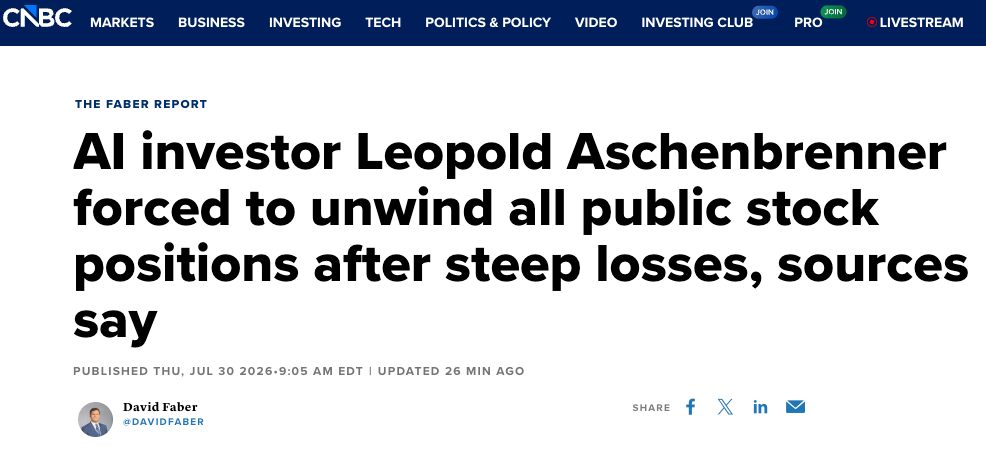
Yesterday the news was plastered all over the internet. Aschenbrenner was hit with margin calls and had to liquidate his public stock positions.
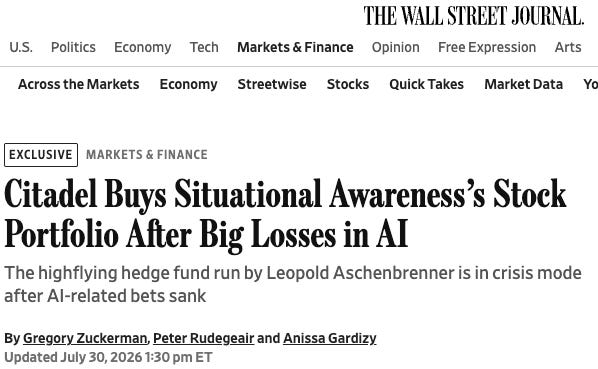
The WSJ then reported that Citadel, Ken Griffin’s hedge fund juggernaut, bought over those positions.
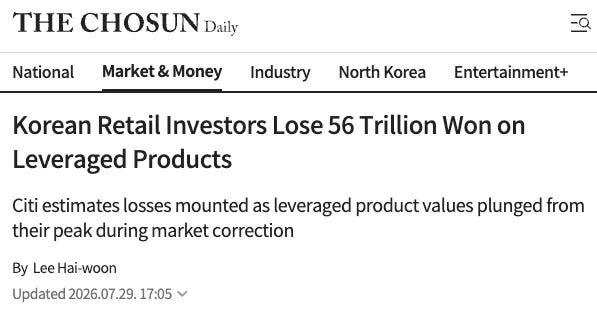
It is easy to point fingers at a hedge fund manager who blew up. But over in South Korea, the exact same thing is happening to mom and pop investors, who took on leverage to bet on the hot AI trend right up until prices became unsustainable. Same mistake, different account size.
What is uncanny is the timing. It coincided with a huge rebound in AI stocks after weeks of heavy selling.
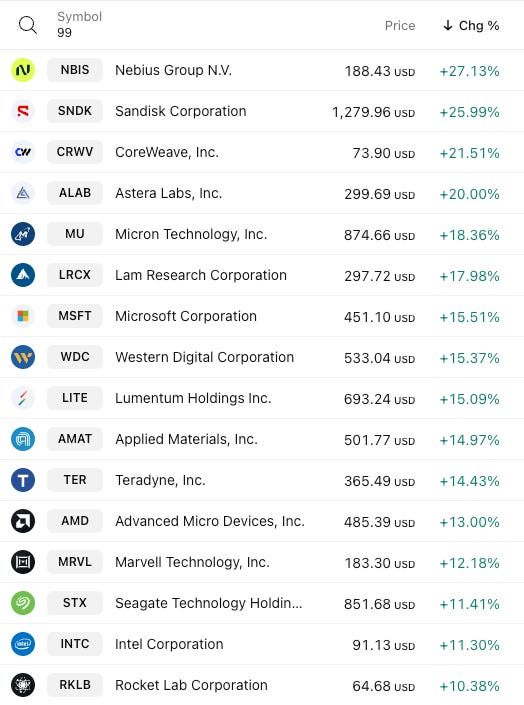
That gives us further validation that the past month of selldown was largely a deleveraging event, not a verdict on the businesses. Investors got complacent, bought with margin, and some were force sold when their collateral fell short.
There are two lessons here.
Lesson 1. Do not take leverage in the first place
First, investors generally should not take leverage when investing. The reason is that as long as you take leverage, there is a chance that you can lose it all. You become fragile.
Here is the math.
Stocks can crash 50% or more. That is not a freak scenario, it is just what markets do.
Now say you take 2x leverage. You have $1m and you borrow another $1m, giving you $2m of exposure. The market drops 50%, and your $2m is worth $1m. Except that $1m belongs to your broker. You walk away with nothing.
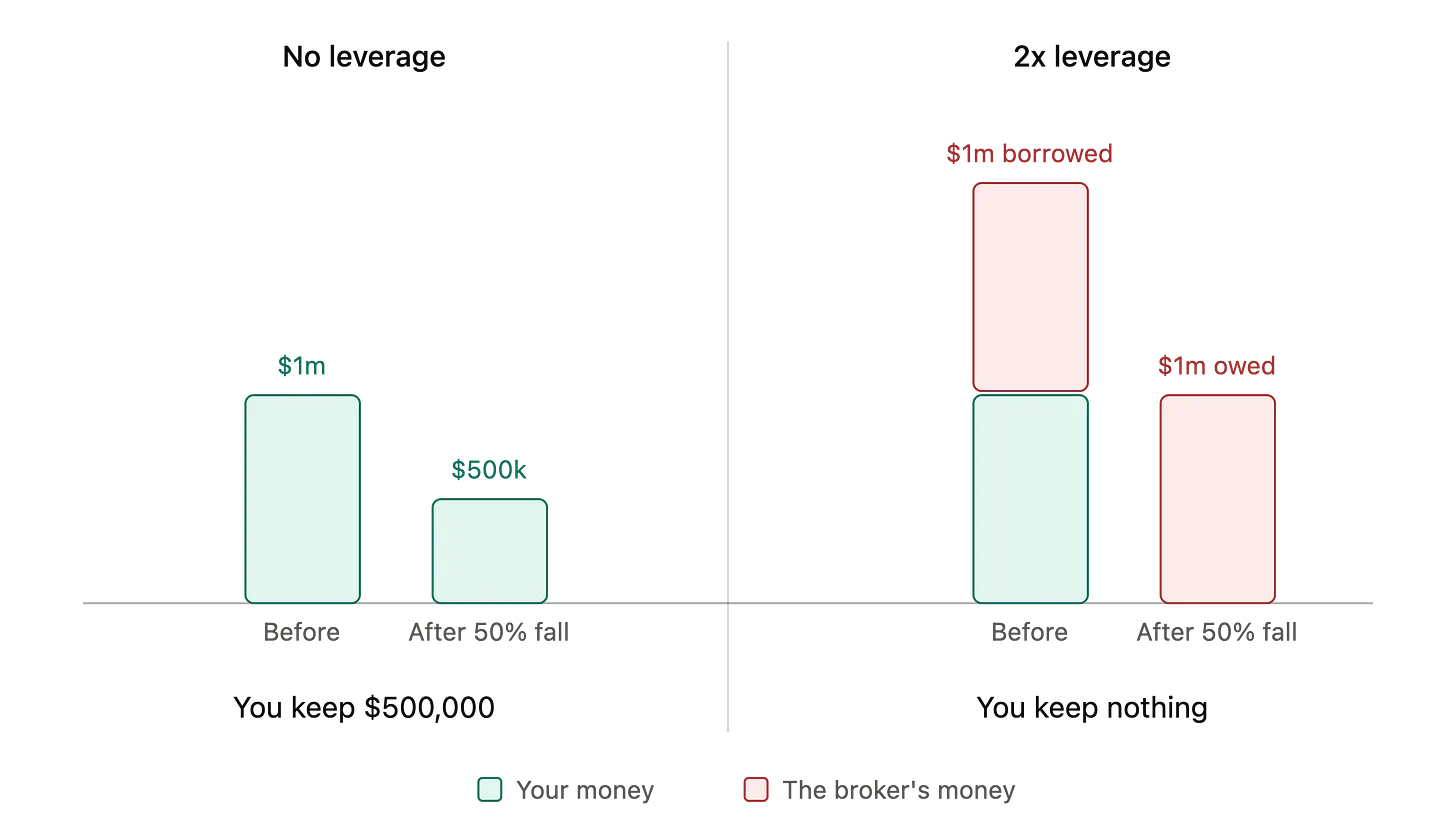
And here is the cruel part. All this selling may well have been unwarranted. The AI trend is structural, chip companies are still making big money, hyperscalers are still spending, and there is no sign of a slowdown. You may have every intention of holding and waiting out the rebound.
But leverage does not give you the luxury of time. The market can rebound eventually. Leverage shortens your runway, the margin call arrives first, and your game is over before you get to be right.
Keynes put it best. Markets can stay irrational longer than you can stay solvent.
Without leverage, you stay in the game for as long as the market takes. To make money, survive first.
Lesson 2. If you have taken leverage, honour your cut loss
Set the level, and when the trigger comes, act on it. Do not delay.
If you set a 10% cut loss, honour it when it happens.
If you set a price to sell, honour it when it happens.
We have already established that leverage can take you to zero. So once you are on leverage, your only job is to limit the damage. The moment you do not honour the cut loss, the problem begins.
I know this well because it happened to me more than ten years ago. I was overleveraged on options. I was selling them, not buying them, so my losses were theoretically unlimited.
I had predetermined cut loss levels. I just did not want to take the loss. So I kept rolling the options and sank deeper into the red, until the margin call came and my broker closed out the entire portfolio. The account closed negative. I still had to repay the difference.
You are probably thinking you would honour yours. Everyone thinks that. But you are thinking it now, calm, with nothing at stake and the market closed. That is not the version of you who has to press the button.
The version who presses the button is watching the position gap down, doing the math on what the loss means, and telling himself it will come back by Friday. He is not calm and he is not the one who wrote the plan.
So leverage plus a stop loss is still a bet. You are not just betting on the market. You are betting on how you will behave under stress, and that is the one variable you have never tested.
It was an expensive lesson, and it has served me well ever since. Best not to take leverage at all, because it makes you fragile. If you must, honour your stop loss and act on it. Stop digging the hole deeper.
So is the AI trade back?
Not so fast. A single day rebound, however strong, proves nothing. The encouraging sign is that the deleveraging may be largely done, which reduces the odds of huge downsides. But asking AI stocks to reclaim their previous highs in a short span of time is asking for too much.
Leopold may yet be proven right on AI. He just will not be around to collect. That is the whole point.